
 Computational
Artificial Intelligence in Basic Education - AI@School
Artificial Intelligence in Basic Education
Curricular Framework
Digital technologies have been transforming the way we communicate, work, and relate to each other, also impacting the economy. They are no longer considered "clean" as they affect nature, and this change is reflected in education. Therefore, it is important to understand which innovation discourses reach the educational environment. What enhances human skills or what merely seeks to maintain the profit and productivity of the new dominant economic groups. In any case, Artificial Intelligence (AI) is an innovation. It is a technology different from others brought by computing. Until then, computing provided tools to assist humans in their various daily tasks. AI, however, is different. For example, a PowerPoint presentation is a tool that has no knowledge, does not reason, has no goals to achieve, and makes no decisions. These characteristics bring it closer to a calculator, whose intentionality depends entirely on the user. AI systems, on the other hand, have distinct characteristics. They adapt to their users. For example, an intelligent search system that seeks to provide potentially useful results, ranks them by relevance, and improves its responses based on user interaction. In other words, it is a proactive system.
In this context, schools need to seek innovative pedagogical methodologies capable of awakening students' interest and enthusiasm. Furthermore, it is necessary to reflect not only on how technology transforms education, but also on what kind of education technology demands. This implies questioning the limits of markedly technological innovation in the face of broader education. With AI gaining ground, it becomes increasingly necessary to understand its impact on human formation.
If new competencies and skills about technologies are needed, new skills and competencies are also needed to live with these technologies, in particular, with AI. It is breaking paradigms. Until now, machine learning AI has driven AI, but it has brought biases sharply, uncertainty in answers, and lack of transparency to increasingly complex algorithms. Subsequently, generative AI has brought new challenges that affect areas considered typically human, such as creativity. Generative AI not only predicts the next word based on past data but also generates texts, audios, images, and videos. Creativity was a skill considered, until now, typically human. Furthermore, creativity brings us more uncertainty and increases distrust in the results of these systems. They are created to provide us with credible answers, not necessarily correct ones.
Within this context, digital skills are also increasingly valued in the job market and, over the past few years, computer education has gained more and more space, whether through digital inclusion programs, specific curricular components, or through its inclusion transversally in other areas of knowledge.
Therefore, the curricular framework for Elementary School (early and late grades) aims to develop the following dimensions: Human-AI Interaction, Perception, Representation and Reasoning, Machine Learning, Social Impact and Ethics.
Dimensions
The curricular framework for Elementary School establishes six fundamental dimensions for AI teaching, ensuring an approach to the benefits and risks of AI. These dimensions are:
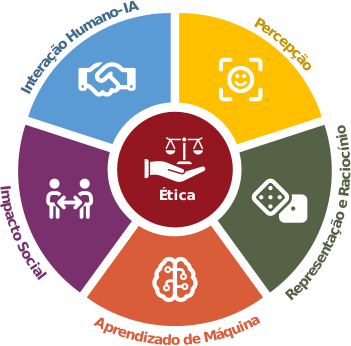
- Human-AI Interaction: This dimension deals with how humans interact with AI systems, considering aspects such as communication, collaboration, and technological mediation. It involves understanding the characteristics of AI, its impact on daily life, and how humans can use it effectively and responsibly.
- Perception: This deals with how AI systems capture data from the world and also from computational bases. This data then goes through a curation phase to be organized into one of the forms of representation.
- Representation and Reasoning: This relates to how AI classifies, structures, organizes, and processes the data obtained in the perception stage and transforms it into knowledge to make decisions and solve problems. It includes the use of algorithms and mathematical reasoning to develop efficient and intelligent computational solutions.
- Machine Learning: Refers to the AI's ability to learn from data, adjusting its behavior over time to improve its performance. This dimension explores different forms of machine learning, such as supervised, unsupervised, and reinforcement learning.
- Social Impact: Discusses the effects of AI on society, including changes in the job market, privacy, security, and inequality. It seeks to promote a critical view of AI use and its ethical, legal, and social implications.
- Ethics: This dimension is transversal to all others and involves reflections on transparency, accountability, privacy, and fairness in the development and use of AI. The goal is to ensure that technologies are applied in a just and beneficial way for society.
The central dimensions address the following subjects (not limited to these): data, with a focus on sensors; recognition and reasoning with a focus on traditional forms of knowledge representation (for example, decision trees, production rules, semantic networks, and symbolic reasoning); neural networks and statistical reasoning; training, where the three traditional machine learning methods will be covered, namely supervised, unsupervised, and reinforcement learning; Human-Computer Interaction, with an emphasis on chatbots and inclusion; social implications of AI, both in daily life and at work; and ethics, which will be addressed transversally across all dimensions.
Aspects
For the progression across levels to be effective, a structured set of knowledge and skills is required to support AI learning. Therefore, the proposed curricular framework follows UNESCO's recommendation "AI Competency Framework for Students" (UNESCO, 2024) with adaptations, as provided for in the document itself in section 5.1.
Two adaptations were made to the UNESCO Framework for Students (2024) to suit Brazil's regional needs. The first adaptation replaces the term “human-centered AI” with “planet-centered AI,” broadening the perspective to include the impacts of this technology on all beings inhabiting Earth. This change also aligns with Brazilian environmental guidelines. The second adaptation introduces the competence “Personal and Professional Development,” considering the reality of many Brazilian students who finish high school and need to enter the workforce. Furthermore, this approach is constantly requested by our partners during fieldwork.
The aspects are necessary to structure AI education, ensuring that students acquire essential knowledge and skills to deal with this technology critically and responsibly. Below is an explanation of each of these aspects:

- Planet-Centric AI: emphasizes the relationship between AI and the environment, addressing human responsibility in the development and use of technology. The idea of "human agency" involves understanding people's role in creating and controlling AI, even being able to deactivate it if necessary. It highlights the need for ethical decisions in the development and application of AI, while "social responsibility" broadens this perspective to ensure positive impacts for all beings inhabiting the planet.
- Foundations: covers the bases of AI, which are mathematics, computation, and data science. In other words, they deal with the theoretical elements that allow AI to function. These foundations enable AI systems to be developed.
- Use and Design: Explores how to design and apply AI techniques to solve real problems. "Problem Scoping" involves identifying challenges that can be solved with AI. "AI Architectures for Problem Solving" refers to using appropriate models and tools to develop solutions. "AI Solution Creation" represents the final stage, where students develop practical applications for specific problems.
- Techniques and Application: Related to the approaches and methods used to make AI work. "AI has various techniques to solve problems" highlights the diversity of machine learning techniques, Natural Language Processing, and Expert Systems. The techniques are used to solve problems in different contexts.
- Personal and Professional Improvement: Prepares students for the relationship between AI and the world of work. "changes in the world of work" addresses how AI impacts careers and productive sectors. "working together with AI" explores how humans and machines can collaborate to achieve better results. Finally, "resilience to adapt one's career" emphasizes the need for flexibility and adaptation to the transformations brought about by AI in the labor market, seeking to master the technology for continued education and the development of new skills.
Competencies and Skills
Specific AI competencies and competencies needed to teach about AI from related fields such as computing, philosophy (ethics), and social sciences (AI and society) are covered.
| # | Competency Description |
|---|---|
| 1 | Understand the principles of planet-centric artificial intelligence, identifying risks, ethical implications, and its applications for society, analyzing challenges and impacts on social coexistence and human rights. |
| 2 | Demonstrate knowledge of the fundamentals of Artificial Intelligence, including basic concepts and operating principles, exercising criticality in the analysis of its limitations, possibilities, and social and ethical impacts. |
| 3 | Evaluate AI systems with ethical solutions for real-world problems and develop creative applications, considering ethical aspects and exploring the potential of artificial intelligence in different contexts. |
| 4 | Understand and apply concepts of artificial intelligence and machine learning, analyzing their possibilities, limitations, ethical impacts, and applications in different contexts. |
| 5 | Relate artificial intelligence to the world of work, investigating how it transforms professions and contributes to the development of new skills. |
To support the practical implementation of the curricular framework and ensure proper learning progression, skills have been defined that detail the knowledge and actions expected of students in each dimension and aspect. These skills organize clearly and objectively what must be taught and learned, serving as a basis for pedagogical planning and for monitoring student development across the various stages. Below are the corresponding skills.
Dimensions Legend (Ethics is a transversal dimension):
 Human-AI Interaction
 Perception
 Representation and Reasoning
 Machine Learning
 Social Impact
| Code | Skill | Aspect | Dimensions |
|---|---|---|---|
| EI03IA01 | Identify, with the educator's mediation, digital information created by humans and that generated by machines, realizing that both can contain errors or inaccuracies. | Techniques and Application | |
| EI03IA02 | Develop habits of balanced and healthy use of technologies, respecting time and purpose limits, reflecting on the consequences of inappropriate use for oneself, for others, and for the environment. | Planet-Centric AI | |
| EI03IA03 | Understand what AI is and recognize that it works through machines and programs, understanding that AI has no feelings or consciousness. | Fundamentals | |
| EI03IA04 | Integrate AI into the creative process, developing sequential stories represented in different artistic languages. | Personal and professional improvement | |
| EI03IA05 | Interact critically with AI responses: discuss what the technology generates, identify limitations, and build a critical view of technological interactions (always with teacher mediation). | Use and Design | |
| EI03IA06 | Integrate children's natural curiosity with the exploration of GenAI, providing meaningful and playful experiences. | Use and Design | |
| EI03IA07 | Explore AI tools, valuing the investigative process as a way to learn about oneself and the world. | Personal and professional improvement | |
| EI03IA08 | Think of solutions and build projects/prototypes as an investigative outcome (connecting creation and problematization). | Use and Design | |
| Code | Skill | Aspect | Dimensions |
|---|---|---|---|
| EF15IA01 | Recognize Artificial Intelligence systems in different contexts, understanding their characteristics, functionalities, and impacts on society, as well as differentiating them from human intelligence. | Planet-Centric AI | |
| EF15IA02 | Manage your personal data responsibly, protecting your privacy. | Planet-Centric AI | |
| EF15IA03 | Understand that Artificial Intelligence requires natural resources to function and that these resources must be used ethically. | Planet-Centric AI | |
| EF15IA04 | Describe real problems and their solutions in natural and mathematical language. | Planet-Centric AI | |
| EF15IA05 | Describe solutions or algorithms that are computable. | Fundamentals | |
| EF15IA06 | Recognize problems and use simple ways to organize information to solve them using classical algorithms | Fundamentals | |
| EF15IA07 | Create solutions by drawing paths (graphs) that show possible options | Fundamentals | |
| EF15IA08 | Use forms of organization and symbolic reasoning to implement solutions | Fundamentals | |
| EF15IA09 | Understand that Artificial Intelligence requires data (from different sources) to function | Use and Design | |
| EF15IA10 | Use multimodal Artificial Intelligence systems in a critical and reflective manner | Use and Design | |
| EF15IA11 | Relate data privacy with ethics in AI | Use and Design | |
| EF15IA12 | Experiment with Artificial Intelligence solutions for inclusion | Use and Design | |
| EF15IA13 | Use simple algorithms to classify and group objects | Techniques and Application | |
| EF15IA14 | Relate machine learning to Artificial Intelligence | Techniques and Application | |
| EF15IA15 | Understand the limits and ethical precautions in the application of AI solutions | Techniques and Application | |
| EF15IA16 | Understand the impacts of AI on social relationships | Personal and professional improvement | |
| Code | Skill | Aspect | Dimensions |
|---|---|---|---|
| EF69IA01 | Exercise the understanding that AI depends on human leadership in its creation and use, with legal and environmental responsibility. | Planet-Centric AI | |
| EF69IA02 | Relate human responsibility and competencies to the intentional and ethical use of AI | Planet-Centric AI | |
| EF69IA03 | Understand the theoretical limits of Computing and Artificial Intelligence | Fundamentals | |
| EF69IA04 | Understand the relationship between Artificial Intelligence and statistics | Fundamentals | |
| EF69IA05 | Evaluate data and its quality, applying initial processing methods | Use and Design | |
| EF69IA06 | Identify the requirements of computational, physical, or virtual systems. | Use and Design | |
| EF69IA07 | Analyze and evaluate responses generated by AI systems, investigating the processes used and exploring alternatives for improvement | Use and Design | |
| EF69IA08 | Apply the life cycle of an AI system, creating a solution that considers ethical principles from conception to implementation, ensuring transparency, equity, and responsibility at all stages. | Use and Design | |
| EF69IA09 | Recognize the ethical and legal implications of using computer systems in Artificial Intelligence in society | Use and Design | |
| EF69IA10 | Understand what deep learning is and how artificial intelligence solves complex problems | Techniques and Application | |
| EF69IA11 | Describe and experiment with an Artificial Intelligence that learns from examples (supervised) | Techniques and Application | |
| EF69IA12 | Describe and experiment with an Artificial Intelligence that learns on its own (unsupervised) | Techniques and Application | |
| EF69IA13 | Describe and experiment with an Artificial Intelligence that uses reinforcement learning | Techniques and Application | |
| EF69IA14 | Compare different types of machine learning in everyday situations | Techniques and Application | |
| EF69IA15 | Train an Artificial Intelligence for specific objectives while respecting ethical and privacy issues | Techniques and Application | |
| EF69IA16 | Understand the relationship between AI and the world of work | Personal and professional improvement | |
| EF69IA17 | Prepare and present Artificial Intelligence problems and solutions clearly and adapted to different audiences | Personal and professional improvement | |
| EF69IA18 | Propose solutions in cooperation with mixed teams (humans and AIs) | Personal and professional improvement | |
| EF69IA19 | Evaluate and critique the outcome of a task in mixed teams (humans and AIs) | Personal and professional improvement | |
| EF69IA20 | Use data responsibly, ensuring privacy and demonstrating personal and social commitment in AI-driven societies | Personal and professional improvement | |
| Code | Skill | Aspect | Dimensions |
|---|---|---|---|
| EM01IA01 | Recognize and relate the different applications of Artificial Intelligence in daily routines. | Use and Design | |
| EM01IA02 | Create with AI by performing pattern recognition, symbolic and statistical reasoning | Fundamentals | |
| EM01IA03 | Reflect from a critical perspective on how AI impacts the world of work. | Personal and professional improvement | |
| EM01IA04 | Recognize the limitations and benefits of AI by comparing its representations in fiction with some of its real-world systems. | Use and Design | |
| EM01IA05 | Know how to communicate with a natural language interface. | Use and Design | |
| EM01IA06 | Understand how the use of databases and dictionaries enables the creation of Predictive Systems. | Techniques and Application | |
| EM01IA07 | Understand how AI can be used for the production and dissemination of fake news, discussing ways to distinguish legitimate content from fake content. | Planet-Centric AI | |
| EM01IA08 | Understand that AI can operate with multiple representation structures for object recognition and concept construction, understanding its mathematical principles | Fundamentals | |
| Code | Skill | Aspect | Dimensions |
|---|---|---|---|
| EM02IA01 | Distinguish types of Artificial Intelligence based on their structures and learning mode. | Techniques and Application | |
| EM02IA02 | Know how to identify AI systems that recognize affective states through images, text, and voice. | Techniques and Application | |
| EM02IA03 | Recognize new ethical issues that arise with the introduction of AI. | Planet-Centric AI | |
| EM02IA04 | Know how to train an AI system. | Techniques and Application | |
| EM02IA05 | Understand the criteria and techniques used for an AI to map routes. | Techniques and Application | |
| EM02IA06 | Understand the Design Cycle involved in the development of AI systems. | Use and Design | |
| EM02IA07 | Understand how AI uses software sensors | Techniques and Application | |
| EM02IA08 | Know how to use recommendation systems actively, seeking to recognize criteria and interfere in the suggested results. | Use and Design | |
| Code | Skill | Aspect | Dimensions |
|---|---|---|---|
| EM03IA01 | Understand how AI is related to the Internet of Things (IoT) and its devices. | Use and Design | |
| EM03IA02 | Know how to interact with chatbots and recognize how AI is used to develop them. | Techniques and Application | |
| EM03IA03 | Know how to train an AI using the Machine Learning technique. | Use and Design | |
| EM03IA04 | Understand the difference between Accuracy and Precision and how AI performance measurements are carried out. | Fundamentals | |
| EM03IA05 | Recognize that AI results depend as much on the quality and diversity of the data as on the algorithms used. | Techniques and Application | |
| EM03IA06 | Understand the AI technologies used in the automation of vehicles and autonomous devices. | Use and Design | |
| EM03IA07 | Understand the concept of Heuristics as one of the foundations of AI to differentiate it from human reasoning. | Fundamentals | |

Brackmann, Christian; Vicari, Rosa Maria; Galafassi, Cristiano; Mizusaki, Lucas.
AI@School. 2024. Available at: www.ianaescola.com.br